
Picture "Bambi" (2016) (Unique piece)
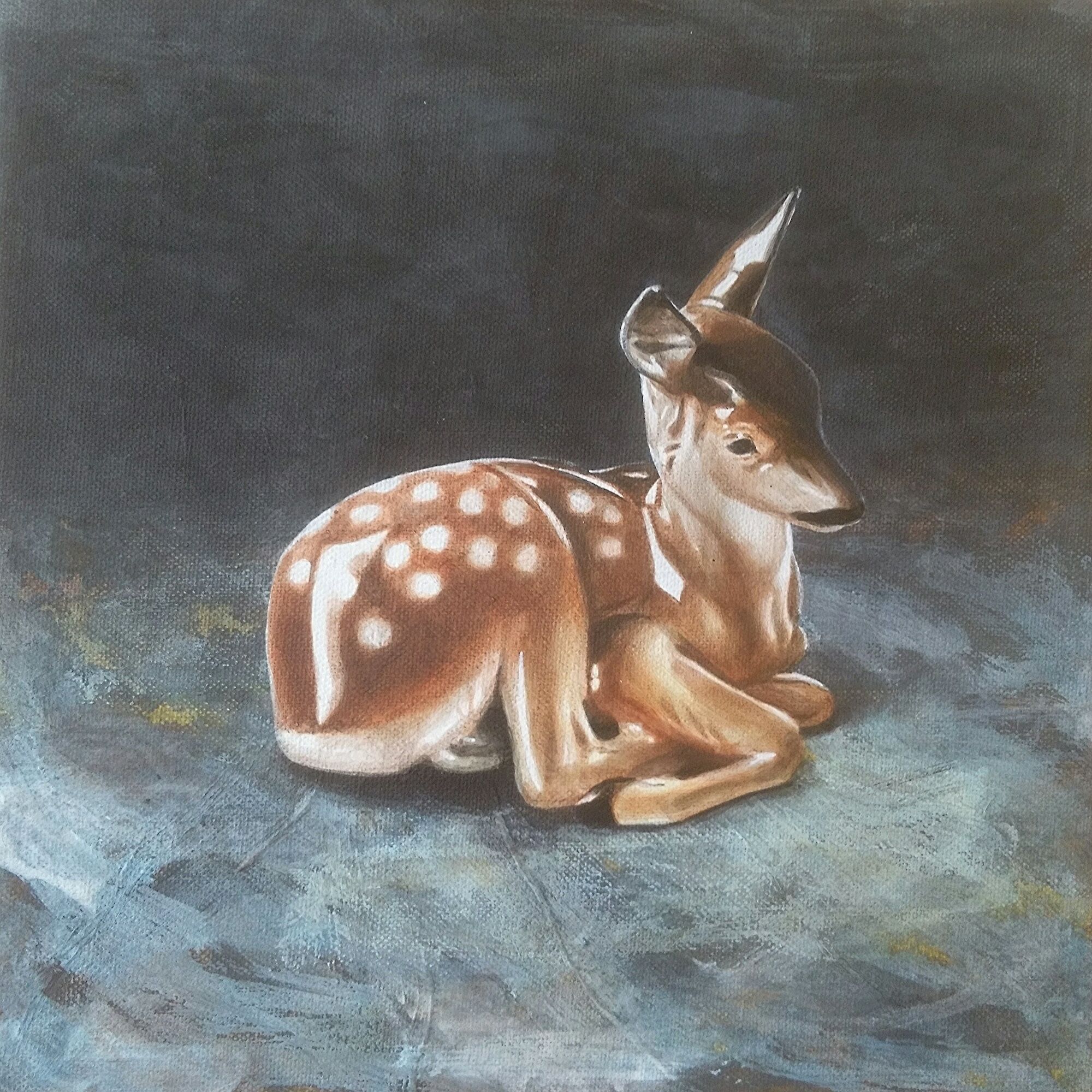


Picture "Bambi" (2016) (Unique piece)
Quick info
unique piece | signed | acrylic on canvas | unframed | size 30 x 30 cm
Detailed description
Picture "Bambi" (2016) (Unique piece)
Acrylic on canvas, 2016, signed. Unframed. Size stretched on stretcher frame 30 x 30 cm.
Producer: ARTES Kunsthandelsgesellschaft mbH, Bödekerstraße 13, 30161 Hannover, Deutschland, E-Mail: [email protected]

About Andreas Amrhein
Andreas Amrhein (born 1963 in Marburg) has been one of the most multifaceted representatives of contemporary German painting for over three decades.
After studying fine arts in London, Malmö, Chicago and Berlin, Amrhein initially began with informal working methods before consistently finding his way to figurative painting under the master class of Walter Stöhrer at the Academy of Arts in Berlin.
This change marks the transition from a purely experimental search for form to a visual language that combines myth, consumerism and pop culture in surprising contrasts.
The porcelain figure has been a central motif in Amrhein's compositions since the early 2000s. Similar to Günther Uecker, who used nails as his signature, Amrhein uses this iconic material to intertwine ‘non-violence and playfulness,’ kitsch and criticism. His borrowings from the great German manufacturers (Meissen, Nymphenburg, KPM, Hutschenreuther) meet Chinese porcelain experiences from working stays in Shanghai and Beijing.
In more recent works, he designs his own hyperrealistic painted figures. In this way, he shifts the traditional object into a contemporary discourse and imbues it with subtle but unmistakable social criticism.
Amrhein's painting oscillates between pop art references, film quotations and symbolic imagery. Cinema classics such as Quo Vadis, The Malte Falco and Hitchcock masterpieces such as The Birds appear in his works in collages with Mephisto figures, Jesus iconography, imposing elephants and filigree storks.
His subjects skilfully play with clichés and cultural archetypes without resorting to banal quotations. In colour and form, Amrhein pushes the visual world to the limits of hedonism: garish colour contrasts, impasto brushstrokes and a detail-obsessed style of illustration convey an immediate, often provocative visual language that questions the everyday.
Andreas Amrhein lives and works in Berlin, where he also inspires young artists as a lecturer at the Academy of Painting. His works have been shown in more than 50 solo and over 75 group exhibitions, including at the Art Institute of Chicago, and are held in renowned private collections such as the Montblanc Collection and Ringier AG. He is represented by prestigious galleries in Germany. The prices for unique pieces range from around €1,000 (small works on paper) to approximately €12,000 (large canvases), which is a moderate investment given their art-historical and social relevance.
Those who purchase Andreas Amrhein's canvas paintings receive not merely a decorative object, but a piece of pop art-like reflection on our present – ironic, provocative and always colourful. His art is a brilliant response to the often dreary triviality of everyday life and invites collectors to reflect on consumption, history and identity with a wink.
A one-of-a-kind or unique piece is a work of art personally created by the artist. It exists only once due to the type of production (oil painting, watercolour, drawing, lost-wax sculpture etc.).
In addition to the classic unique pieces, there are also the so-called "serial unique pieces". They present a series of works with the same colour, motif and technique, manually prepared by the same artist. The serial unique pieces are rooted in "serial art", a genre of modern art that aims to create an aesthetic effect through series, repetitions, and variations of the same objects or themes or a system of constant and variable elements or principles.
The historical starting point is considered to be Claude Monet's "Les Meules" (1890/1891), where, for the first time, a series was created that went beyond a mere group of works. The other artists, who addressed to the serial art, include Claude Monet, Piet Mondrian and above all Gerhard Richter.