
Picture "Halle, Uni-Ring in Autumn" (2012) (Unique piece)
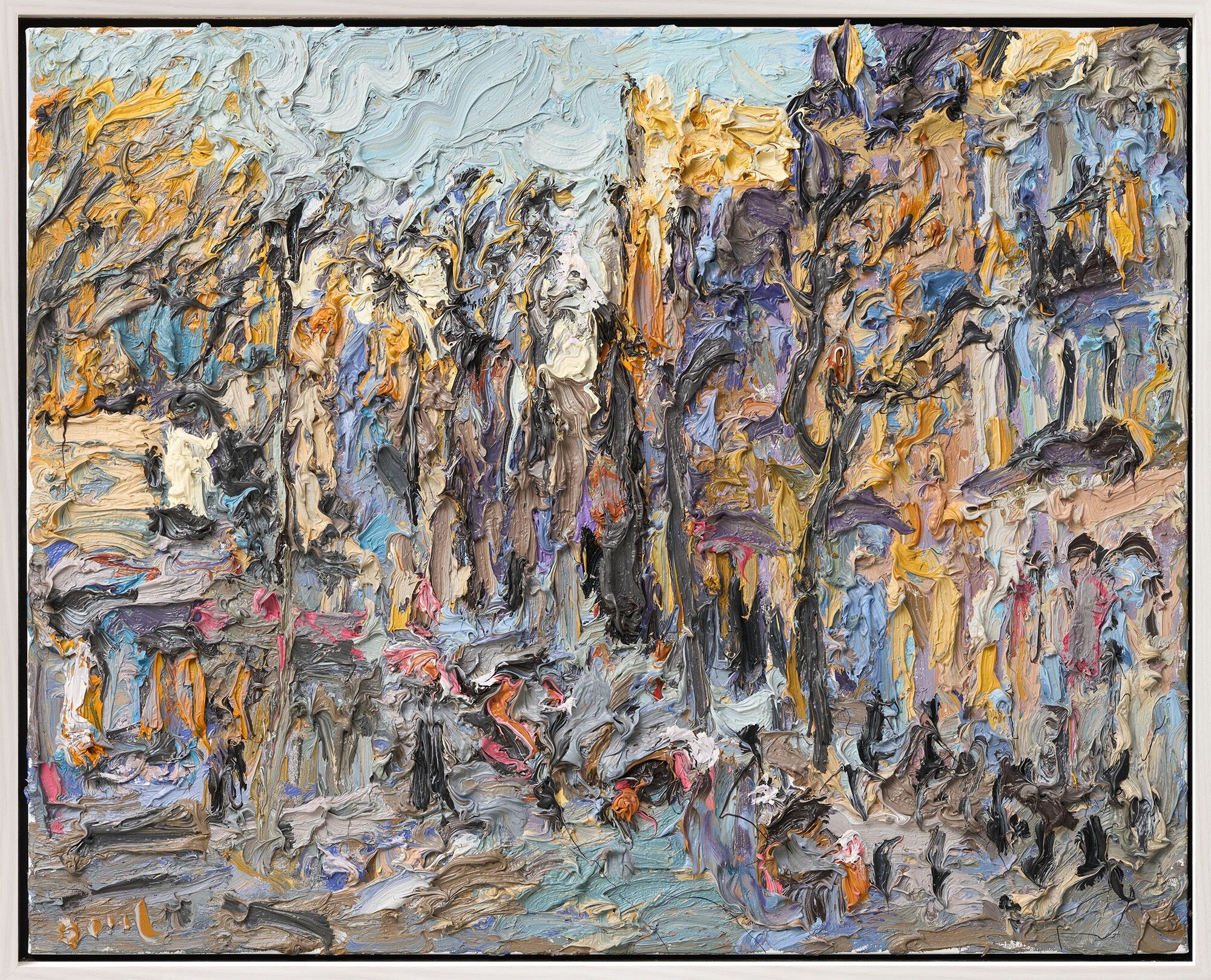


Picture "Halle, Uni-Ring in Autumn" (2012) (Unique piece)
Quick info
unique piece | signed | oil on canvas | framed | size 84 x 104 cm
Detailed description
Picture "Halle, Uni-Ring in Autumn" (2012) (Unique piece)
Oil on canvas, 2012, signed. Size 80 x 100 cm. Size in frame 84 x 104 cm as shown.
Producer: ARTES Kunsthandelsgesellschaft mbH, Bödekerstraße 13, 30161 Hannover, Deutschland, E-Mail: [email protected]

About Christoph Bouet
Christoph Bouet's works are impressive simply due to their sheer material presence: the oil paints are several centimetres thick on the canvases of his large-format paintings. He spreads thick clumps of paint – sometimes directly from the tube – onto the canvas and builds up the image layer by layer. Bouet uses up to 20 tubes for a single painting. The result of his technique is an impressive and unique visual experience. Like waves in a stormy sea, powerful structures rise from the mass of paint. Depending on the distance and angle of view, they create a different impression: when standing very close to the canvas, the abstract reliefs made up of vast quantities of paint are particularly fascinating. However, when viewed from a distance, the subjects of the paintings emerge clearly from the seemingly chaotic sea of colours. The highly structured surface also creates the illusion of movement and dynamism.
Bouet has found his thematic focus in nature and landscapes. He often draws inspiration from real places throughout Europe. Berlin's Wannsee, Ahrenshoop near Hamburg and Lake Tegernsee are represented here, as are Livorno, Monte Carlo and Paris. In addition to landscapes, Bouet also devotes himself to still lifes and portraits. His models have included Wolfgang Schäuble, Joachim Gauck and Hasso Plattner.
Formally, Bouet's motifs belong to the figurative genre, but in their execution he often approaches abstraction. In any case, Bouet's painting is difficult to assign to any existing style. His approach and motifs show clear parallels to Impressionism. He also dissolves the contours of his subjects and concentrates on the atmosphere of the moment. At the same time, however, his works also appear impulsive and expressive, which in turn brings to mind various forms of expressionism.
Christoph Bouet, born in 1974, passed the preliminary aptitude test at the Burg Giebichenstein University of Art and Design in Halle at the age of 14. He also studied painting there from 1992 to 1999 and graduated with a diploma. Since then, he has been working successfully as a freelance artist and regularly exhibits his works throughout Germany.
Your advantages: Buy Christoph Bouet at ARTES
In addition to an impressive selection of works by renowned artists such as Christoph Bouet, ARTES offers first-class service. Buyers enjoy a unique right of return – you can purchase a Christoph Bouet work from us with complete peace of mind; the risk of misjudgement lies entirely with us. The authenticity of all Bouet originals is guaranteed by certificates, and secure shipping ensures that the artwork arrives well packaged and undamaged. We are also happy to visit you at home or in your office by appointment and bring one or more works for you to view.
With over 40 years of experience in the art trade and a focus on maximum customer satisfaction, ARTES is the ideal partner. If you would like to find out more about the artworks, please feel free to contact us.
A one-of-a-kind or unique piece is a work of art personally created by the artist. It exists only once due to the type of production (oil painting, watercolour, drawing, lost-wax sculpture etc.).
In addition to the classic unique pieces, there are also the so-called "serial unique pieces". They present a series of works with the same colour, motif and technique, manually prepared by the same artist. The serial unique pieces are rooted in "serial art", a genre of modern art that aims to create an aesthetic effect through series, repetitions, and variations of the same objects or themes or a system of constant and variable elements or principles.
The historical starting point is considered to be Claude Monet's "Les Meules" (1890/1891), where, for the first time, a series was created that went beyond a mere group of works. The other artists, who addressed to the serial art, include Claude Monet, Piet Mondrian and above all Gerhard Richter.