
Picture "Ostend, Casino" (1917) (Unique piece)


Picture "Ostend, Casino" (1917) (Unique piece)
Quick info
unique piece | signed | dated | titled | inscribed | watercolour over pencil on paper | framed | size 63 x 49 cm
Detailed description
Picture "Ostend, Casino" (1917) (Unique piece)
During the First World War, Erich Heckel served as a medical soldier in Flanders. Despite the grim circumstances, artistic work remained existentially necessary for him. In numerous drawings and watercolours, he captured the topographical, urban, and landscape impressions of Flanders - not documentary, but filtered through an engaged, personal vision. Between 1915 and 1918, Heckel was stationed in Ghent, Roeselare, and especially Ostend, where he began in February 1917 expanding a military hospital near the railway station. Despite harsh external conditions, a remarkable body of work emerged, often confronting the horrors of war directly, yet also exploring peaceful subjects - cityscapes, landscapes, the sea, and cloud formations.
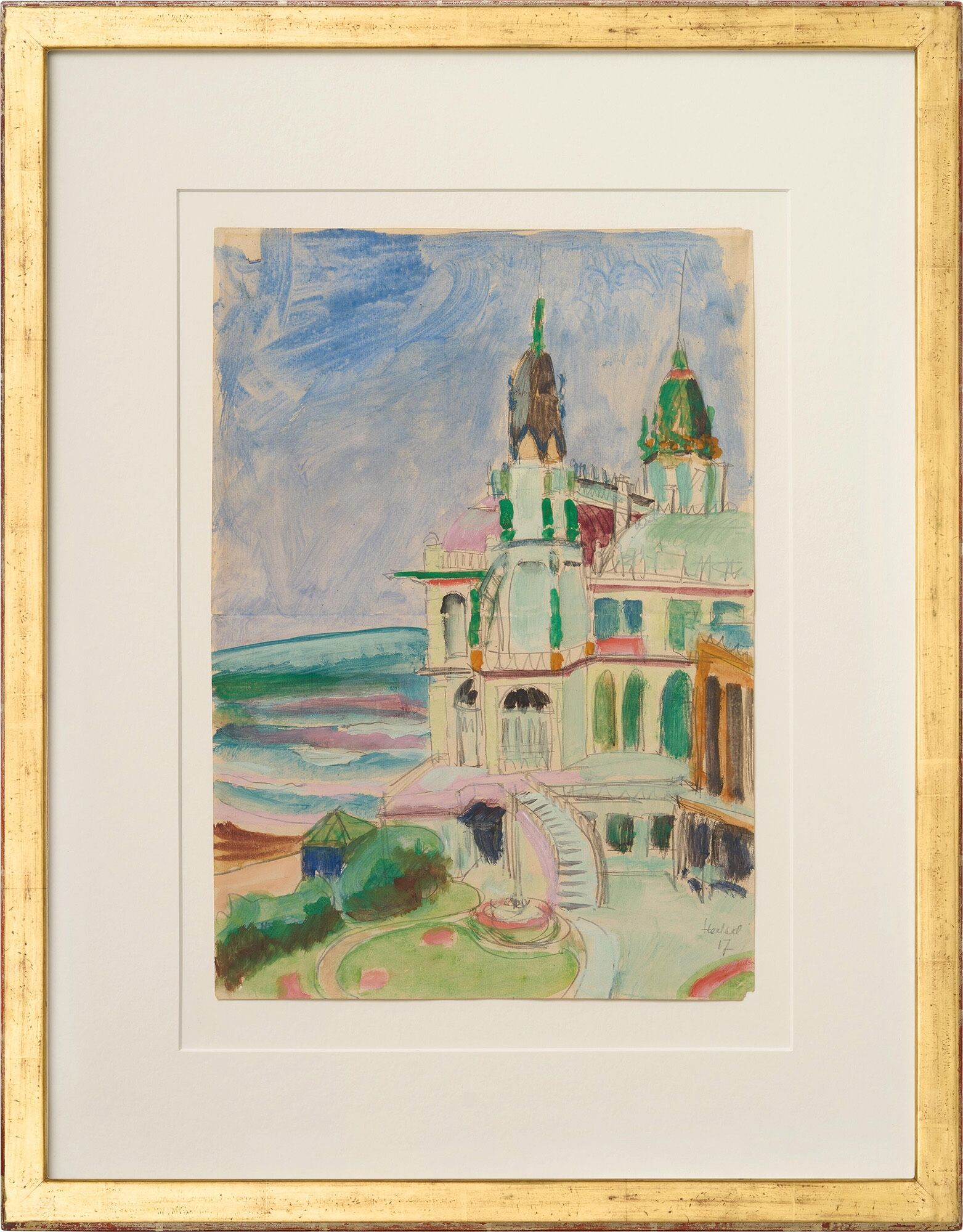
The present watercolour, "Ostend, Casino", was created in this context. It depicts the grand seafront architecture of Ostend Casino - not as an exact topographical study, but as a visionary condensation. Curved lines, rhythmic colour flows of the sea, lively sky textures, and the cheerful colour of domes and towers create a scene that transcends reality. The eye travels over the building to the horizon, as if seeking spiritual openness in the vastness of the sea.
"Ostend, Casino" is a copy of Heckel's ability to create pictures of poetic power and quiet presence even in the context of war. It is a composition of memory, but also one of inner resistance - a celebration of contemplation, born in the midst of a time of destruction.
Watercolour over pencil on paper, 1917. Signed and dated lower right. Titled lower left on the back and marked "EH 733" in the centre. Motif size/sheet size 43 x 30 cm. Frame size 63 x 49 cm as shown.
Producer: ARTES Kunsthandelsgesellschaft mbH, Bödekerstraße 13, 30161 Hannover, Deutschland, E-Mail: [email protected]

About Erich Heckel
Erich Heckel (1883-1970) is one of the most important artists of German Expressionism. In 1905, together with Ernst Ludwig Kirchner, Karl Schmidt-Rottluff and Fritz Bleyl, he founded the legendary artists' group "Die Brücke" in Dresden, which later Max Pechstein, Emil Nolde and Otto Mueller joined.
After World War I Heckel developed a new, cosmopolitan classicism that was accompanied by a more naturalistic approach and a brightening of the palette. In the 1920s, he produced numerous landscape works, including the unusually large charcoal drawing of the 'Westerholz Mill', which is still a popular touristic destination in Schleswig-Holstein.
Erich Heckel's works are represented in the world's leading museums and collections.
Painting with glazing watercolours, that are characterised by their transparency, which let deeper layers and painting surfaces shine through.
Often the paper surface is omitted. This contributes significantly to the effect of the work. The aquarelle or watercolour painting requires skilful use of colour, as it dries quickly and corrections are almost impossible.
A one-of-a-kind or unique piece is a work of art personally created by the artist. It exists only once due to the type of production (oil painting, watercolour, drawing, lost-wax sculpture etc.).
In addition to the classic unique pieces, there are also the so-called "serial unique pieces". They present a series of works with the same colour, motif and technique, manually prepared by the same artist. The serial unique pieces are rooted in "serial art", a genre of modern art that aims to create an aesthetic effect through series, repetitions, and variations of the same objects or themes or a system of constant and variable elements or principles.
The historical starting point is considered to be Claude Monet's "Les Meules" (1890/1891), where, for the first time, a series was created that went beyond a mere group of works. The other artists, who addressed to the serial art, include Claude Monet, Piet Mondrian and above all Gerhard Richter.