
Picture "Premature Autumn" (1961) (Unique piece) New


Picture "Premature Autumn" (1961) (Unique piece) New
Quick info
unique piece | inscribed | watercolour on handmade paper | framed | size 35 x 30 cm
Detailed description
Picture "Premature Autumn" (1961) (Unique piece)
We're sorry, but there is no English translation for this item yet. If you are interested in the size or the material of this product, please have a look at the German description as stated below.
Als Literat prägte Hermann Hesse ganze Generationen, doch auch seinen Aquarellen liegt ein besonderer Zauber inne. Sie eröffnen eine eigene künstlerische Welt, in der Landschaft, Stimmung und persönliche Empfindung unmittelbar miteinander verbunden sind.
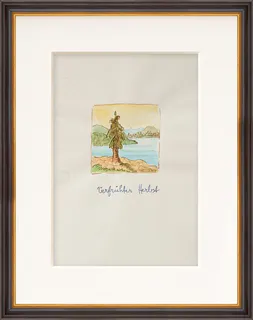
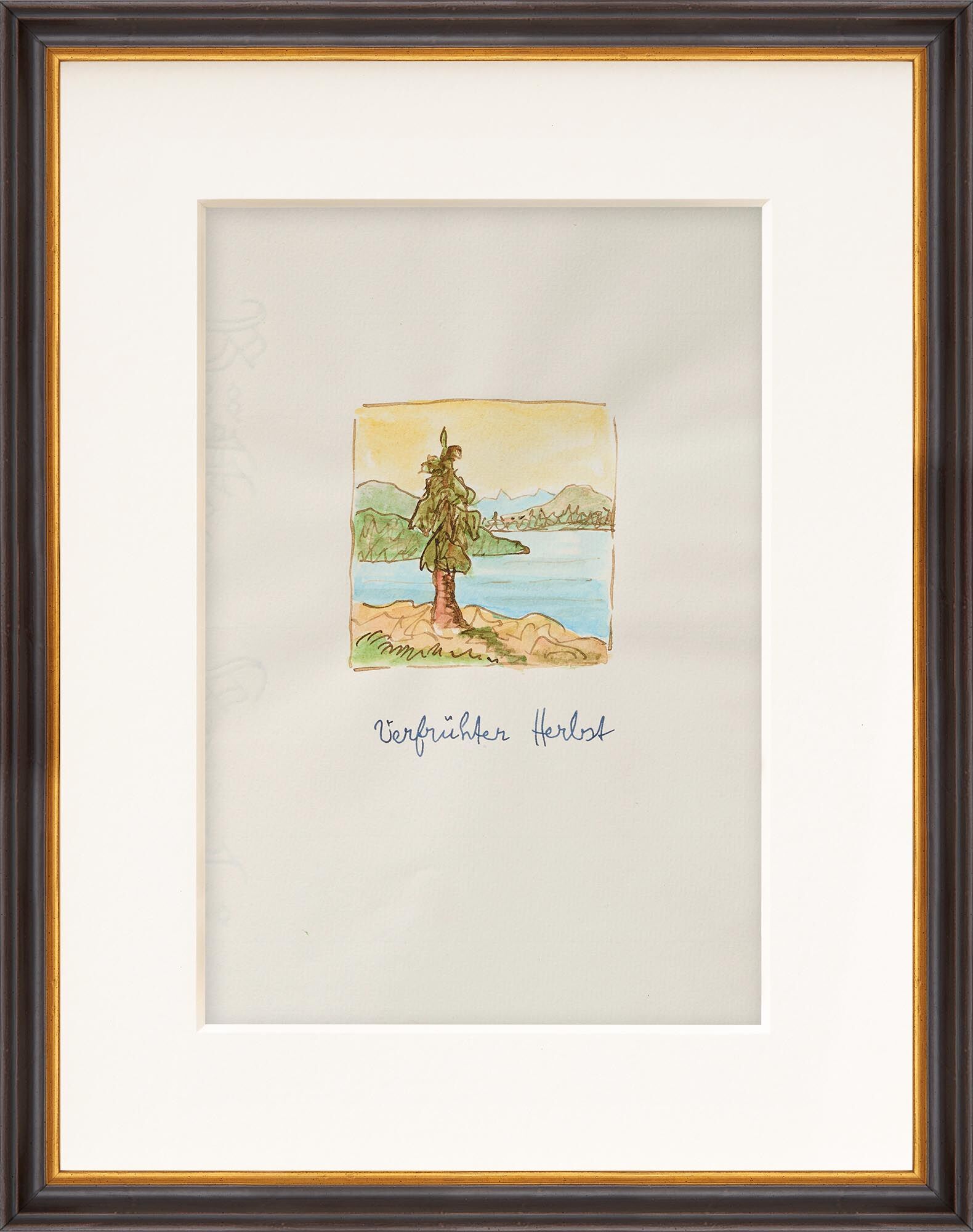
Dafür steht exemplarisch das zarte Aquarell mit der einsamen Tanne: ein kleines, stimmungsvolles Werk, dessen Wirkung gerade aus seiner Reduktion entsteht. Die Tanne befindet sich am Ufer eines Sees, hinter dem sich die Hügel in den Horizont verflüchtigen. Nichts lenkt von diesem Baum und der stillen Landschaft ab. Gelbe und braune Töne verweisen auf den schmerzlichen Abschied vom Sommer und damit indirekt auch auf die eigene Vergänglichkeit.
Das Aquarell gehört zu Hesses handgeschriebenen Gedichtblättern rund um das Gedicht „Verfrühter Herbst“, die er mit Aquarellen und Tuschzeichnungen illustrierte. Er verschenkte oder verkaufte sie und unterstützte damit die Kriegsgefangenenfürsorge und andere Organisationen.
Aquarell und Zeichnung sowie handgeschriebenes Gedicht auf Büttenpapier, 1961. Blatt aus einer Mappe mit 12 Gedichten "Geschrieben und gemalt im Spätherbst 1961". Motivgröße/Blattformat 14,8 x 10,5 cm. Format im Rahmen 35 x 30 cm wie Abbildung.
Producer: ARTES Kunsthandelsgesellschaft mbH, Bödekerstraße 13, 30161 Hannover, Deutschland, E-Mail: [email protected]
About Hermann Hesse
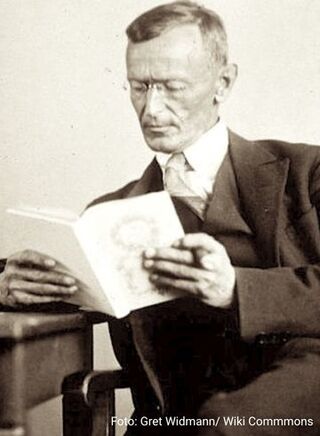
Hermann Hesse (1877-1962) is known worldwide primarily as a writer, particularly for works such as "Siddhartha" and "Steppenwolf". What is less well known is that Hesse was also a passionate painter, draughtsman and graphic artist. Even in his youth, he showed a keen interest in the visual arts: he produced drawings, watercolours and sketches, often featuring landscapes, plants, animals and fantastical scenes.
Hesse’s painting style is characterised by a blend of European traditions and Far Eastern aesthetics - ranging from the clarity of Japanese ink drawings to the sensitive observation of nature found in Romantic landscape paintings. Many of his works have a meditative quality and invite the viewer to pause, focus on the details and immerse themselves in the tranquillity of his paintings.
For Hermann Hesse, his art was a kind of inner sanctuary. Many of his works were created during the years he lived in Montagnola in Ticino. There, the landscape captivated him so much that he repeatedly painted the hills, the light over the lakes and the leaves of the trees. He often used watercolour, ink or pencil, giving his pictures a light, flowing character, almost like visual poems.
Although his painting long stood in the shadow of his literary works, it is now regarded as an important expression of his personality. It shows that Hesse explored the world not only with words, but also with colours and lines – always in search of harmony, beauty and inner clarity. His art complements his literature perfectly: both reflect the same sensitive, reflective spirit that seeks deeper meaning in the world.
Painting with glazing watercolours, that are characterised by their transparency, which let deeper layers and painting surfaces shine through.
Often the paper surface is omitted. This contributes significantly to the effect of the work. The aquarelle or watercolour painting requires skilful use of colour, as it dries quickly and corrections are almost impossible.
A one-of-a-kind or unique piece is a work of art personally created by the artist. It exists only once due to the type of production (oil painting, watercolour, drawing, lost-wax sculpture etc.).
In addition to the classic unique pieces, there are also the so-called "serial unique pieces". They present a series of works with the same colour, motif and technique, manually prepared by the same artist. The serial unique pieces are rooted in "serial art", a genre of modern art that aims to create an aesthetic effect through series, repetitions, and variations of the same objects or themes or a system of constant and variable elements or principles.
The historical starting point is considered to be Claude Monet's "Les Meules" (1890/1891), where, for the first time, a series was created that went beyond a mere group of works. The other artists, who addressed to the serial art, include Claude Monet, Piet Mondrian and above all Gerhard Richter.