
Picture "At Walchensee" (1923) New
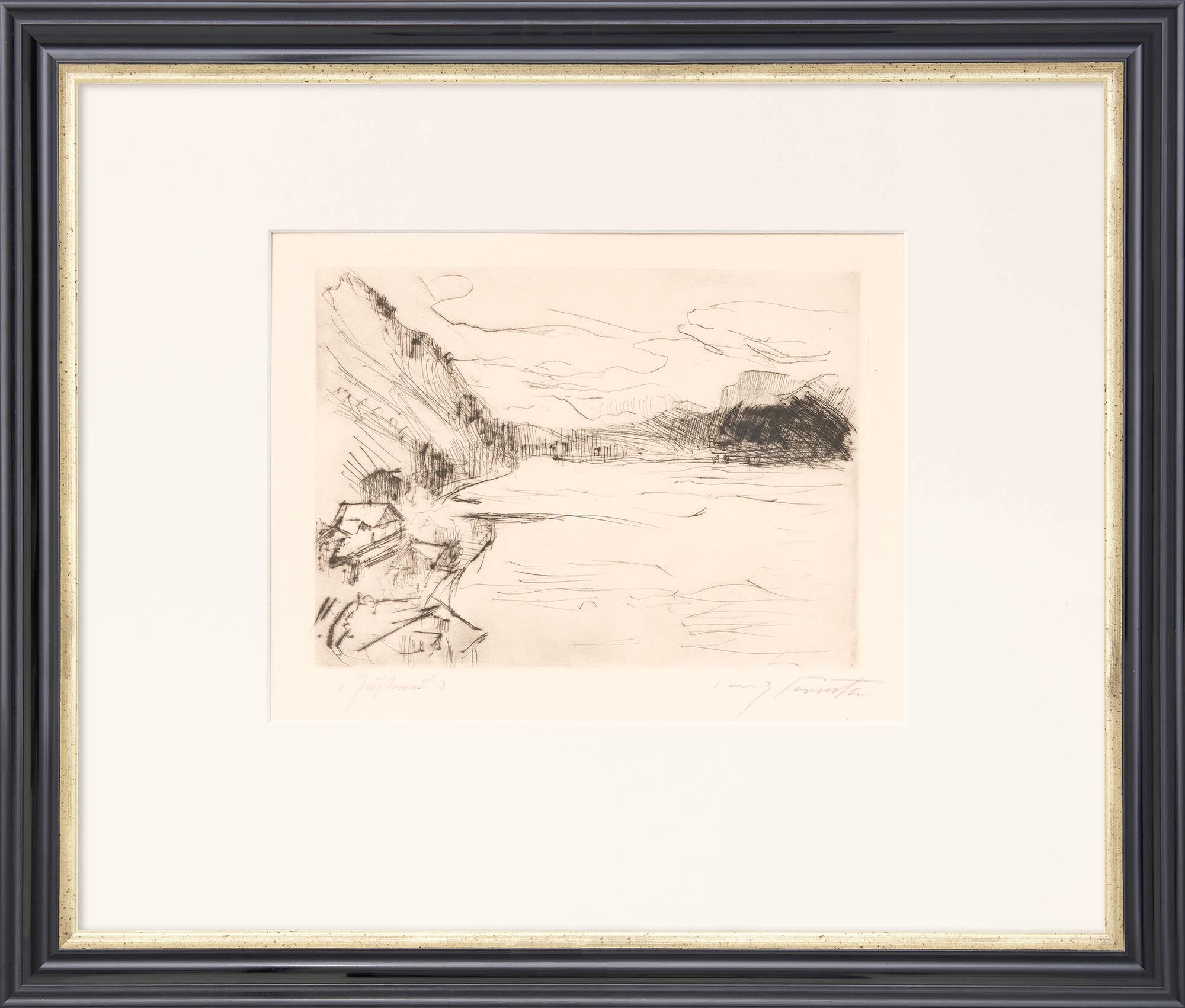


Picture "At Walchensee" (1923) New
Quick info
limited | signed | inscribed | etching on Japanese and handmade paper | framed | size 48 x 56 cm
Detailed description
Picture "At Walchensee" (1923)
Drypoint, 1923. Edition: unspecified edition on handmade paper, signed and marked "State 3". According to the Catalogue raisonné, the edition was burnt. This work is therefore considered a rare copy. Catalogue raisonné: Müller 674. Motif size 17.7 x 24.2 cm. Sheet size 22.5 x 28.5 cm. Size in frame 48 x 56 cm as shown.
Producer: ARTES Kunsthandelsgesellschaft mbH, Bödekerstraße 13, 30161 Hannover, Deutschland, E-Mail: [email protected]
About Lovis Corinth
"True art (...) has no practical, utilitarian flavour. It exists solely for itself. Egotistical like a god, it stands before us in all its radiance." (Lovis Corinth)
The work of Lovis Corinth (1858-1925) is difficult to define as a whole. It is even questionable to classify his work as "German Impressionism" as opposed to French Impressionism - Corinth certainly experimented with the effect of colour in the sense of giving autonomy to the pictorial means. But he was mostly alien to scientific-academic calculations, colour systems, or the justification of colour effects rooted in physics. In general, he opposed the artistic trends of his time, and even scorned many of the new approaches of the young avant-garde as "formula art".
But at first glance, Corinth only appears to be a "conservative" painter. On the one hand, he remained attached to the figurative, realistic style of painting throughout his life. His sources of inspiration remained the old Dutch, above all Rembrandt, and he died near Amsterdam because he wanted to admire the originals there once more. However, on the other hand, he was regarded as a rebel and innovator, and always revisiting classical genres (historical paintings, biblical, and mythological themes) with a highly subjective eye, even to the point of parody and travesty. Thus, ultimately, he was completely and utterly an outstanding contemporary of his artistic epoch and was perceived as such. He was modern in every sense, and the series of his famous self-portraits show the sometimes-unstable Corinth, torn between artistic intoxication and depression, as a master of psychological self-interpretation.
Corinth's late work is of particular importance. First of all, there are the Walchensee paintings, created from 1919 onwards near Urfeld in southern Munich, where the painter rediscovered landscape painting for himself. But he also sought and found new approaches in other subjects, such as portraits and still lifes.
Your benefits: Buy Lovis Corinth at ARTES
In addition to the impressive selection of works by renowned artists such as Lovis Corinth, ARTES offers a first-class service. Buyers enjoy a unique right of return - you can buy a Lovis Corinth work from us with complete peace of mind, the risk of a misjudgment lies entirely with us. The authenticity of all Corinth originals is guaranteed by certificates and secure shipping ensures that the artwork arrives well packaged and undamaged. We are also happy to visit your home or office by appointment and bring one or more works to you for viewing.
With over 40 years of experience and a focus on maximum customer satisfaction, ARTES is the ideal partner. If you would like to find out more about the artworks, please contact us.
The field of graphic arts, that includes artistic representations, which are reproduced by various printing techniques.
Printmaking techniques include woodcuts, copperplate engraving, etching, lithography, serigraphy, among others.