
Picture "Reclining Nude" (1917) (Unique piece)
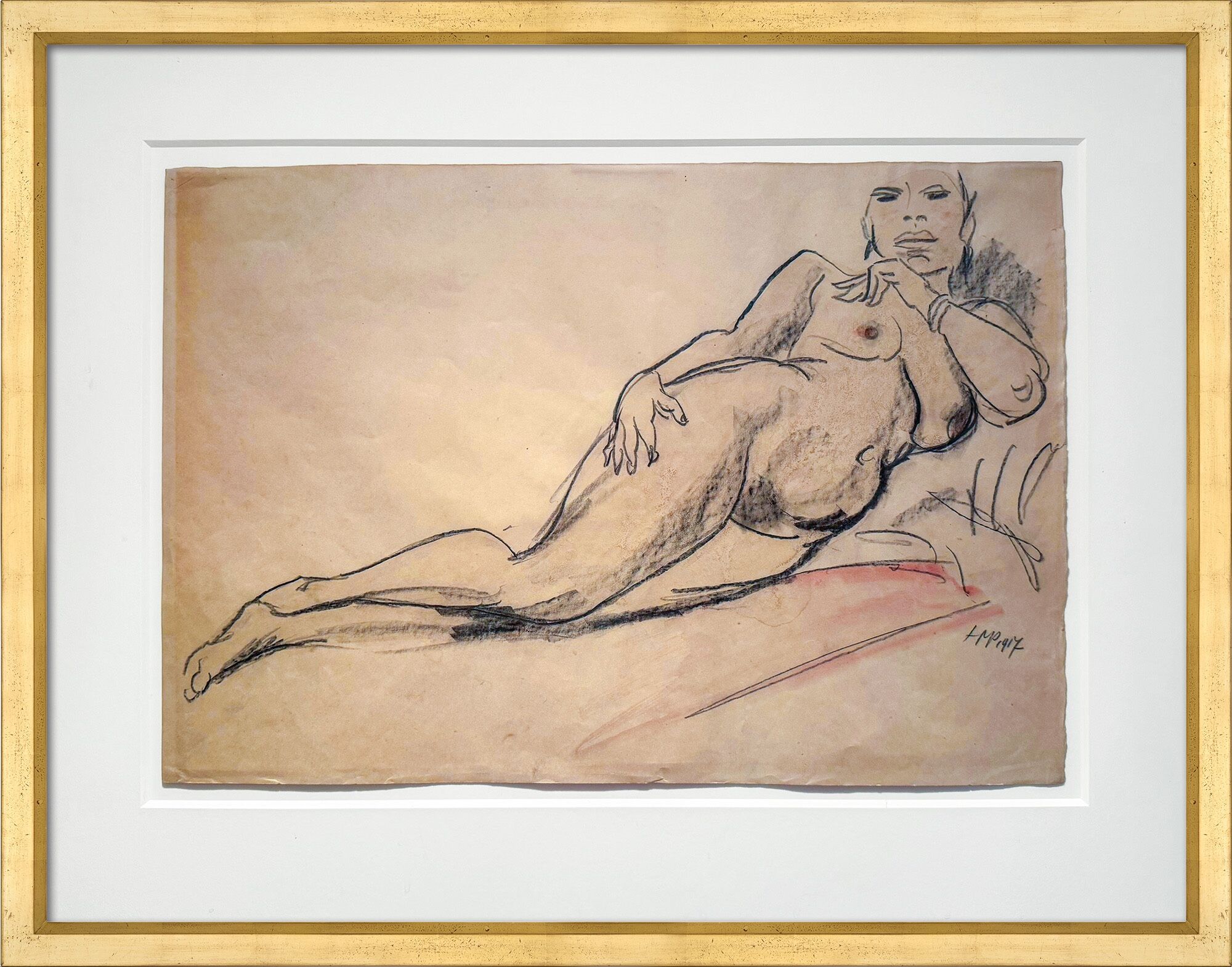


Picture "Reclining Nude" (1917) (Unique piece)
Quick info
unique piece | monogrammed | dated | mixed media on paper | framed | size 51 x 65 cm
Detailed description
Picture "Reclining Nude" (1917) (Unique piece)
Max Pechstein understood the nude not merely as a classical subject but as a central expressive medium for an immediate connection of nature, body, and sensation. His figure drawings convey elemental energy, far beyond academic study. With swift, confident strokes and often coloured accents, they give the human body rhythmic presence, reflecting the perception of the moment. Pechstein was less concerned with anatomical accuracy than with the physically felt, the primal, and the sensually immediate. His nudes combine an archaic appearance with a longing for authenticity and natural harmony.
The work "Reclining Nude" is a characteristic example of this. The reclining figure unfolds in a powerful yet sensitively modelled composition. Watercolour adds lightness and transparency, while charcoal and pencil provide contours and volume. This singular work exemplifies an expressionist depiction of the body, oscillating between sensuality, formal rigor, and inner movement.
Pencil, charcoal and watercolour on paper, 1917. Monogrammed and dated. The authenticity of this work has been confirmed by Alexander Pechstein. Motif size/sheet size 35 x 50 cm. Size in frame 51 x 65 cm as shown.
Producer: ARTES Kunsthandelsgesellschaft mbH, Bödekerstraße 13, 30161 Hannover, Deutschland, E-Mail: [email protected]
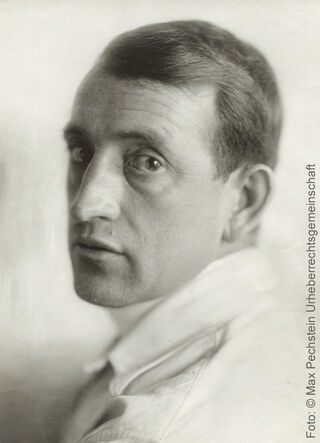
About Max Pechstein
1881-1955
Max Pechstein is considered today, as he was then, one of the most important representatives of German Expressionism. In spring 1906, he joined the artists' group "Die Brücke", which had been founded the previous year by Kirchner, Heckel, Schmidt-Rottluff and Bleyl. In the field of graphic art, he produced an oeuvre of over 850 woodcuts, lithographs and etchings in addition to his paintings.
What Tahiti was to Paul Gauguin, the Baltic Sea coast was to Max Pechstein: a paradise where he found peace, but above all great inspiration. From 1909 onwards, he travelled several times to Nidden on the Curonian Spit, where Lovis Corinth had worked as a young art student more than a quarter of a century earlier. However, when the Treaty of Versailles placed the Curonian Spit under Allied administration in 1920, the way there was blocked. In his own words, Pechstein had to "once again go in search of a spot of earth that was not overrun by painters, tourists and bathers". He found it in Leba, where from then on he spent his summers on a regular basis.
"For more than twenty years Max Pechstein went to the Baltic coast every summer, first to the Curonian Spit, then to Pomerania, which naturally connected him closely to our house. When he rented a room here with his first wife in 1921, he had no idea how attached he would soon feel to the small harbour town of Leba, for he fell in love with Marta Möller, the daughter of his innkeeper. The pristine nature with its beach lakes and the fishing boats in the harbour, the pipe in his mouth, tanned and the anchor tattooed, those things stayed with the passionate angler Pechstein until the end of his life, even when he and his wife could no longer go to Pomerania after the Second World War." (Dr. Birte Frenssen, Deputy Director at the Pomeranian State Museum in Greifswald)
Graphic artwork in the making of which the artist combines at least two graphic production techniques.
A one-of-a-kind or unique piece is a work of art personally created by the artist. It exists only once due to the type of production (oil painting, watercolour, drawing, lost-wax sculpture etc.).
In addition to the classic unique pieces, there are also the so-called "serial unique pieces". They present a series of works with the same colour, motif and technique, manually prepared by the same artist. The serial unique pieces are rooted in "serial art", a genre of modern art that aims to create an aesthetic effect through series, repetitions, and variations of the same objects or themes or a system of constant and variable elements or principles.
The historical starting point is considered to be Claude Monet's "Les Meules" (1890/1891), where, for the first time, a series was created that went beyond a mere group of works. The other artists, who addressed to the serial art, include Claude Monet, Piet Mondrian and above all Gerhard Richter.