
Picture "Glass of the Day" (1984) (Unique piece)
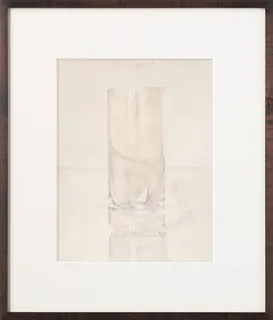
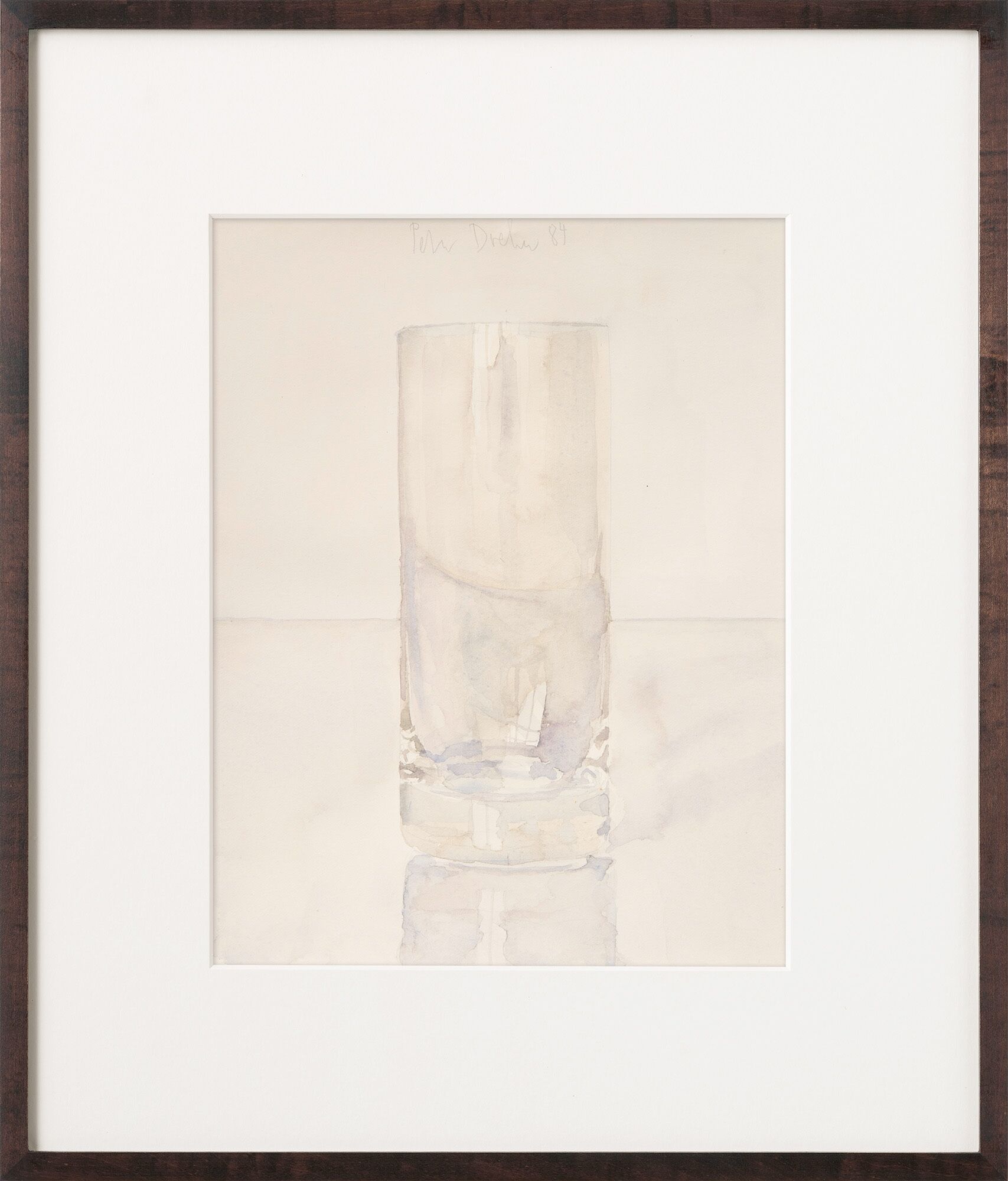


Picture "Glass of the Day" (1984) (Unique piece)
Quick info
unique piece | signed | dated | watercolour and pencil on wove paper | framed | size 43 x 38 cm
Detailed description
Picture "Glass of the Day" (1984) (Unique piece)
The watercolour "Glass of the Day" is exemplary of Peter Dreher’s artistic practice, which is based on the repeated depiction of an empty water glass.
In this work, the glass appears in an objective frontal view and even daylight, with the watercolour technique particularly emphasising transparency, light refraction and material fleetingness.
Dreher uses the technical reduction of his minimalist compositions of clear lines and controlled colour gradients to focus on the essentials: light, materiality and perception. The apparent repetition is not an end in itself, but part of an analytical process that makes seeing itself the subject.
Watercolour and pencil on wove paper, 1984. Signed and dated. Motif size/sheet size 25.5 x 21.5 cm. Framed size 43 x 38 cm as shown.
Producer: ARTES Kunsthandelsgesellschaft mbH, Bödekerstraße 13, 30161 Hannover, Deutschland, E-Mail: [email protected]
About Peter Dreher
Peter Dreher (1932 - 2020) was born in Mannheim in 1932. He studied under Erich Heckel at the State Academy of Fine Arts Karlsruhe and was later a professor at its branch in Freiburg im Breisgau, where he lived and worked until his death in 2020.
From 1974 to 2017, the artist produced more than 5,000 works showing an empty water glass in the work cycle “Tag um Tag guter Tag I (Nachtserie)” and “Tag um Tag guter Tag II (Tagserie)”.
Dreher said about his very conceptual way of working: “The deliberate restriction to the same motif is not a sacrifice for me and is also not based on the idea of creating a particularly crazy concept to increase my recognition value or to distinguish myself from my colleagues. I chose the supposed limitation in order to focus all my energy on what is really important and decisive for me: painting.”
The artist's works can be found in internationally renowned collections, including the MMK Museum of Modern Art in Frankfurt am Main, the Frieder Burda Museum in Baden-Baden, the Pinault Collection and the Art Institute of Chicago.
Painting with glazing watercolours, that are characterised by their transparency, which let deeper layers and painting surfaces shine through.
Often the paper surface is omitted. This contributes significantly to the effect of the work. The aquarelle or watercolour painting requires skilful use of colour, as it dries quickly and corrections are almost impossible.
A one-of-a-kind or unique piece is a work of art personally created by the artist. It exists only once due to the type of production (oil painting, watercolour, drawing, lost-wax sculpture etc.).
In addition to the classic unique pieces, there are also the so-called "serial unique pieces". They present a series of works with the same colour, motif and technique, manually prepared by the same artist. The serial unique pieces are rooted in "serial art", a genre of modern art that aims to create an aesthetic effect through series, repetitions, and variations of the same objects or themes or a system of constant and variable elements or principles.
The historical starting point is considered to be Claude Monet's "Les Meules" (1890/1891), where, for the first time, a series was created that went beyond a mere group of works. The other artists, who addressed to the serial art, include Claude Monet, Piet Mondrian and above all Gerhard Richter.